
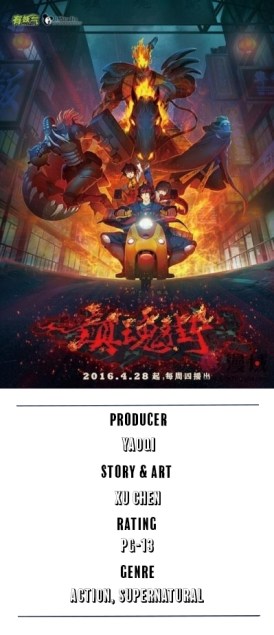
 Have you ever wondered where people go after they die? According to Rakshasa Street (Zhen Hun Jie), a Chinese manhua series created by Xu Chen, they go to a realm between the Human and Spirit World known as a Requiem Street, a place where spirits without salvation wait until they can go to Ghostdom. Due to never-ending warfare in the Human World, the number of spirits being taken in continues to increase. In order to protect and maintain order over the residents in each given area, the Spirit World enables select rare-souled humans with guardian spirits to watch over a Requiem Street as Requiem Generals. These Generals remain diligent and well-aware of their sects, allowing them to stop the spirits from being consumed by darkness and turning evil. One such street is Rakshasa Street, home to the Cao family, and the Sacred Pagoda Tree that both guards the Ghostdom, and sets the story into motion.
The Story
Released in 2016, there are a total of 24 episodes for the adapted original net anime (ONA) series. The episodes contain scenes from the past and present that intermingle together, taking turns between each other to show the story’s progression. The past portion, also known as the heart-wrenching prequel of the series, lives up to its name, Yin, with overwhelming success. In this part of the story, we are introduced to the protagonists, Cao Xiao Liang and Cao Yan Bing. Xiao Liang, a young boy at the time of his introduction, hears his mother give birth to his little brother Yan Bing, and goes back into the house to meet the newest addition to the family. The moment the two meet, Yan Bing grabs Xiao Liang’s finger, 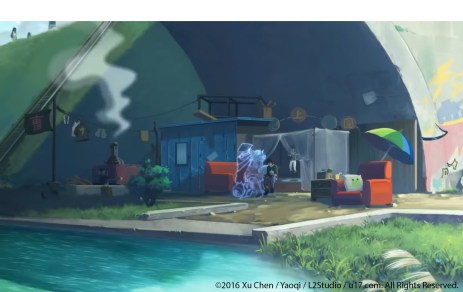 and this interaction becomes the symbol of dedication the brothers share throughout the rest of the series. Their father later talks with Xiao Liang, who promises to protect his human baby brother. This moment foreshadows the next scene, where their parents leave and never return. Xiao Liang remains the dutiful older brother by taking care of Yan Bing while waiting for their parents. That is, until a new Requiem General assigned by the Ghostdom comes to take over Rakshasa Street. After being locked in a room and told his brother is to be thrown out of the borders of their world to die, Xiao Liang manages to breakout and retrieve baby Yan Bing before narrowly escaping to the Human World. More cruelty awaits them before Xiao Liang discovers his guardian spirit, Yu Jin, and after the two manage to save Yan Bing from death once more, the three begin their new life together.
Although still far from what they had before, the two brothers manage to live with relative comforts under a bridge for four years. One day, Yan Bing asks about where they came from and what their parents were like. Xiao Liang offers to show Yan Bing their old home, and with enthusiastic excitement from Yan Bing, the two later cross the gate and into the other world. Their arrival to Rakshasa Street provokes the Requiem General into action, and their lives are once again turned upside down as they become separated once more. After several events, Xiao Liang finds his way back to Yan Bing, but makes a hard decision soon after that causes their relationship to change for the rest of the prequel. By the end, Yan Bing realizes what he was forced to forget, but at a cost neither of them ever wanted to pay.
The present portion, Yang, also stays true to its name. This part of the series contains a piece of the Rakshasa Street Arc from the manhua, and is considered the start of the series. It has a much more energetic tone to it that cranks up on the comedy, but still maintains its serious edge. In this arc, Yan Bing, nicknamed as the “Flame General”, is now 20 years old, is known for having the legendary Warrior Body, and is the newest Requiem General of Rakshasa Street. By his side is his older brother, who is nicknamed as “Bomber”, and acts as the logical and observant half of the duo. Rakshasa Street now houses both humans and spirits that live side-by-side. One day, while out on a delivery for his job, Yan Bing barely misses hitting a girl in the middle of a crosswalk. This girl turns out to be the newest additional 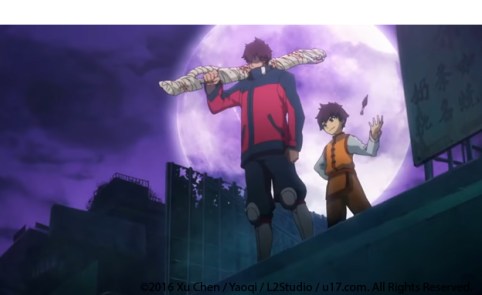 protagonist to the series, named Xia Ling, a rare-soul user and freshly graduated college student who is in search of a normal job. Events lead them together and within days, Yan Bing becomes her trainer so she may unlock her guardian spirit’s heart chain. The Kingdom Organization steps onto the scene and we come to find out they are after Xia Ling for what her guardian spirit supposedly possesses. A few planned attacks and a piece of Sacred Pagoda Tree later, Xia Ling has unlocked her guardian spirit, only for him to break the Sacred Pagoda Tree. With the tree now in need of repair and the Kingdom Organization vowing to retrieve her and her guardian spirit, Xia Ling decides to go and retrieve the necessary materials needed to mend what she has broken. Yan Bing makes a decision to go with her, and after reaffirming his brotherly bond with Xiao Liang by grabbing his finger and choking viewers up inside, he sets out on his journey with Xia Ling to save Requiem Street.
This ONA isn’t an anime per say, because it was produced in China, but it contains all the ingredients needed to make a solid animated series. Therefore, it’s considered one in my book. I’ve seen a few Chinese animes before, but this one is the only one that managed to hold my attention from beginning to end. It has a solid storyline, excellent character and story development, alluring music, moving scenes, noble themes, and hilarious anime references from some of the hottest shows in Japan. This series had me from the get-go.
Every hero needs a tragic backstory.
Xu Chen is obviously a fan of Japanese anime, because he knows the necessary tropes. Every successful hero has a tragic beginning. They need a background that catches the attention and sympathy of his or her viewers. In the case of the brothers, Xiao Liang was left alone to raise Yan Bing on his own. For Yan Bing, it was losing his big brother through manipulation. Xia Ling may also be a protagonist, but her weak backstory fails to gain the sympathy needed to make her a prominent figure in the ONA. She is shown to be more of a comic relief than anything.
Family bonds are forever.
 While it’s another trope used in many animes, it is also something fans around the world can feel a connection towards. Remember Edward and Alphonse Elric from Fullmetal Alchemist? They lost their parents, only had each other, and formed a bond that could never be severed. Big siblings take care of their little siblings. It’s just what we do because our siblings are family and we love them. This point is made very early on in the series by Xiao Liang and Yan Bing’s father. No matter the setback or obstacle, Xiao Liang did everything in his power to protect his little brother, even when it meant gaining his hate. *cough*Naruto*cough*. The symbolic use of Yan Bing grabbing his big brother’s finger even as an adult is a touching moment to see. Older and younger siblings everywhere understand the feelings that come with an action like this. From a younger sibling’s perspective, it means love and trust. From an older sibling’s perspective, it means that no matter what, we’ll protect and love you till our dying breath. Xiao Liang obviously takes this oath very seriously.
If you want something, you need to believe in yourself.
There are many moments in this series where Yan Bing mentions how earning your own power requires hard work and dedication. “The strength of a person has nothing to do with gender.” When Xiao Liang, who obviously was a fantastic ro-model for Yan Bing while he was growing up, says this to Xia Ling, I immediately gave a hearty thumbs up. Xia Ling seems to be fighting against a mentality where she believes she cannot do anything without someone’s help. Throughout her training, Xia Ling repeatedly mentions the difference between gender and how she can’t do what Yan Bing asks of her. The turning point comes when she is about to take a branch from the Sacred Pagoda Tree, but then decides against it, realizing she has always taken the quick and easy way out. “Real strength is not only [having] the ability to fight, but also patience.” Guifa Santong’s mysterious copycat’s words ring deep. If there is something you really want, don’t let anything stop you. Xiao Liang and Yan Bing never let their own obstacles get in the way. They kept fighting for it, and climbed every hurdle needed to reach their goals. By deciding to take responsibility and go on a journey to acquire the necessary materials for mending the Sacred Pagoda Tree, she proved that she can believe in herself and her own strength. As Naruto would say, “Believe it!”
The anime references were spot on.
Oh, the laughter that ensued thanks to the Japanese animes mentioned in this ONA. From Naruto’s summoning jutsu, Gut’s dragonslayer, Zoro’s three-sword training method, to “I didn’t make you shout ORAORAORA”, this anime had me in stitches by the time Xia Ling’s training came to an end. Let’s not forget how Xiao Liang and Xia Ling played maid and butler to one another, or how her training regimen was made from manga such  as Dragon Ball Z, Slam Dunk, and another Chinese manhua called Tiger x Crane. The character Guifu Santong and his mysterious copy-cat are in reference to the famous Kakashi Hatake as well. Not only that, but during Xia Ling’s scene in her room, she tried countless methods to summon her guardian spirit. Edward Elric’s alchemy form was used, Card Captor Sakura’s card summons was employed with a cooking spoon, Toy Story’s iconic ball was used as a Poké Ball, a backscratcher was used for an “Expecto Patronow” spell, Gandalf’s phrase was reworded as “you should now pass” accompanied by a mop, and all within a perceived few quick minutes. The guardian spirits being a mix of Shaman King and JoJo was also a nice addition to complete the anime love found in this ONA.
CG and 2D animation, combine!
Let’s begin by clearing out the elephant in the room. Yes, it’s obvious, Xiao Liang and Yan Bing are both hot. Really, really hot. Think, ‘martial artists with the ultimate vanilla and chocolate pudding cheesecake mix that make them every girl’s desire’ hot. One’s tempered, and one’s relaxed. One is a guilty pleasure, the other is a dark craving. What’s even better, is that they’re animated with not just looks, but with great personalities too. Aside from their character designs, their emotions and actions were clearly displayed throughout the ONA. It’s normally a hit or miss when CG and 2D are combined, but the  two genres worked well in complementing each other in fight scenes and changes in perspective. The color usage was aesthetically pleasing, and the color palettes chosen for each moment worked well in displaying their given emotion. The proportions were uniform with the settings, the perspective stayed congruent, and best of all, the backgrounds enhanced their accompanied scenes with perfect coordination. The storyboarding was also a job well done, especially as both past and present continued to progress. Although the animation could use some improvement, the overall presentation was better than any Chinese animation I’ve seen thus far. This ONA was a balancing game, and the two sides worked like the yin and yang of the series. Perfectly in-sync.
The music made me want to save Rakshasa Street too.
One of the most important aspects of any series is the music. It complements the work and adds meaning to it, especially in anime, which is why the music for Rakshasa Street works so well. Music has no language barriers. It acts as an extension of the heart, and speaks in a way we otherwise can’t. The songs capture the origin of the ONA, its depth, the characters’ struggles, and the emotional intensity it imbues. NZBZ’s “Shine” and “Never Turn Back (Bu Yuan Hui Tou)” were clearly the songs meant to inspire and encourage belief in the characters, while Huang Ling’s “Waiting” let you relive the brothers’ history as well as their newfound strength and determination.
There’s more to come!
The manhua is still going strong, and apparently, so might its ONA. While there’s been nothing confirmed yet, the popularity of this series is unquestioned, and fans continue to await the next installment of the series with anticipation. In the meantime, a live action adaption is scheduled to be released sometime this year, so keep watch, fellow fans, as we may be in for a treat!
Final Thoughts
For those who read the manga, it’s obvious how far this ONA strays from its original manhua. While this may throw some viewers off kilter, there was a reason for this madness, and it was to develop the foundation of the story. The ONA starts similarly to the manhua, but does not complete the entirety of the first part of the series, the 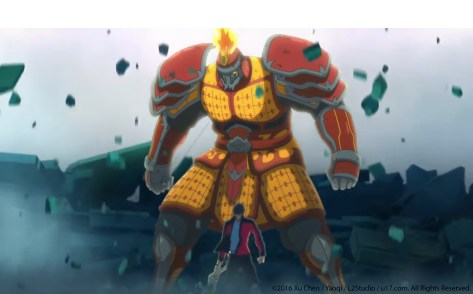 “Rakshasa Street Arc”. Instead, it only shows the story up until Yan Bing and Xia Ling depart for their journey. The 24 episodes act as the prequel and introduction to the series, and as the beginning to the overall plot. I found this to be a well-thought-out move on the producer and director’s part. The past and present portions mixed together as enacting “yin” and “yang” of one another, and created a headier tone to the overall work. The art style and presentation was enjoyable, and I will definitely see this show again. Now, if you’ll excuse me, I need to try summoning up my own guardian spirit. Rakshasa Street, here I come! Wait for me, Xiao Liang, Yan Bing!

Want to watch the series and see if you have your own guardian spirit? It’s available with subtitles on YouTube right now straight from the publisher! So what are you waiting for?! Go visit the world of Rakshasa Street now!
©2016 Xu Chen / Yaoqi / L2Studio / u17.com. All Rights Reserved.


 Anime Go PLUS+
Leave a comment